9.11 Pathloss Correlation
The concept of a simple correlation model for shadow fading has been widely adopted in LTE co-existence studies mostly employed in uplink case. The propagation attenuation is modelled as the product of the path loss and the shadow fading. The shadow fading is well approximated by a log-normal distribution. Let z denotes shadow fading in dB with zero mean and variance σ2. Then the shadow fading of path from one UE to the i-th BS is expressed as
 (Eq. 64)
where a2+b2=1 and x and yi are independent Gaussian distributed variables, both with zero mean and variance σ2 . yi and yj for are independent as well.
Figure 207 presents how to set-up the pathloss correlation in SEAMCAT (only available for OFDMA). The panel is similar for the OFDMA DL and UL.
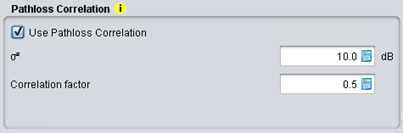
Figure 207: Illustration of the pathloss correlation – input parameters
Thus, the correlation coefficient of the shadow fading from one UE to two different BSs, i.e., the i-th and j-th BS, is
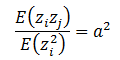 (Eq. 65)
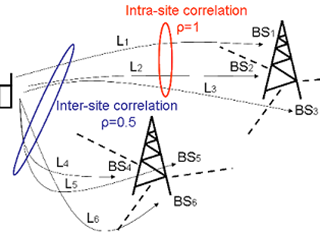
In most LTE studies, is assumed [10]. For cellurar systems with three-sector antennas, the shadowing correlation between sites (equivalent to BS in Omni antenna system) is of 0.5 and correlation between sectors of the same site is consequently of 1.