# 9 OFDMA module

# 9.1 Introduction

The current <span><span class="_kqswh2mm"><span class="_5pioz8co _189e1dm9 _1il9buyh _19lc184f _d0altlke">OFDMA</span></span></span> module has been designed for a Long Term Evolution (LTE) network from 3GPP ‎\[12\]. Therefore <span><span class="_kqswh2mm"><span class="_5pioz8co _189e1dm9 _1il9buyh _19lc184f _d0altlke">E-UTRA</span></span></span> <span><span class="_kqswh2mm"><span class="_5pioz8co _189e1dm9 _1il9buyh _19lc184f _d0altlke">RF</span></span></span> coexistence studies can be performed with Monte-Carlo simulation methodology.

The general simulation assumptions are presented in this section to provide a guideline on how to perform coexistence simulations. The <span>OFDMA</span> DL (downlink) LTE algorithm implemented in SEAMCAT assumes a 100% loaded system and each user is allocated with a fixed number of resource blocks. This is equivalent to modelling a Round Robin scheduler with full buffer traffic model and a frequency reuse of 1/1 (i.e. Single Frequency Network is assumed). The <span>OFDMA</span> algorithm as implemented in SEAMCAT takes into account the intra system interference into the reference cell, caused by UEs located in adjacent cells and using the same RBs but also caused by UEs located in the reference cell which are using different RBs. The <span>OFDMA</span> UL (uplink) LTE algorithm implemented in SEAMCAT is similar to the <span>OFDMA</span> DL LTE algorithm with one exception. In the <span>OFDMA</span>, UL system it is possible to load the system with a set number of resource blocks rather than only 100% load like in the <span>OFDMA</span> DL system (see 9.3.6).

The network layout is similar to the one used for <span><span class="_kqswh2mm"><span class="_5pioz8co _189e1dm9 _1il9buyh _19lc184f _d0altlke">CDMA</span></span></span>. The methodology assumes that the UEs are deployed randomly in the whole network region according to a uniform geographical distribution. The wrap around technique is employed to remove the network deployment edge effects.

Note that if the <span>OFDMA</span> is a DL interferer, the <span>OFDMA</span> is simulated as in “traditional” simulation with the BSs transmitting at full power. This decreases the simulation time of a full <span>OFDMA</span> simulation. In <span>OFDMA</span> DL interferer case, only the position of the BSs will be calculated because full transmit power is assumed. For all other simulations (including UL) scenarios full <span>OFDMA</span> network simulation is required. Consequently, some of the input parameter of the GUI interface have been grey-out when the <span>OFDMA</span> DL interferer case is selected.

Since it is arguable that some simulation assuming a rural environment would not need to assume full power transmission (i.e. full loaded network) when the system is DL and interferer, you may need to manipulate either the input power or the spectrum mask (or both) in order to simulate the DL interferer case for rural deployment.

# 9.2 OFDMA system tab

# Introduction

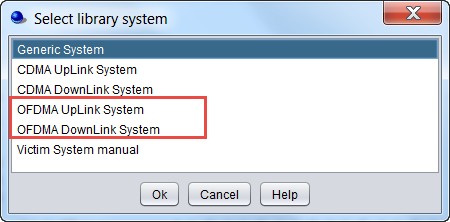
Whether you want to simulate <span data-highlighted="true" data-vc="highlighted-text"><span class="_kqswh2mm"><span class="_5pioz8co _189e1dm9 _1il9buyh _19lc184f _d0altlke" data-testid="definition-highlighter">OFDMA</span></span></span> <span data-highlighted="true" data-vc="highlighted-text"><span class="_kqswh2mm"><span class="_5pioz8co _189e1dm9 _1il9buyh _19lc184f _d0altlke" data-testid="definition-highlighter">UL</span></span></span> or <span data-highlighted="true" data-vc="highlighted-text">OFDMA</span> DL, you can import

<div class="inline-extension-renderer css-e2q2ep" id="bkmrk-"><div data-testid="inline-image"><div class="_1e0c1nu9" role="presentation"><a class="_ymio1r31 _ypr0glyw _zcxs1o36 _mizu1v1w _1ah3dkaa _ra3xnqa1 _128mdkaa _1cvmnqa1 _4davt94y _4bfu1r31 _1hms8stv _ajmmnqa1 _vchhusvi _kqswh2mm _ect4ttxp _syaz13af _1a3b1r31 _4fpr8stv _5goinqa1 _f8pj13af _9oik1r31 _1bnxglyw _jf4cnqa1 _30l313af _1nrm1r31 _c2waglyw _1iohnqa1 _9h8h12zz _10531ra0 _1ien1ra0 _n0fx1ra0 _1vhv17z1">![](blob:https://ecowiki.atlassian.net/ff7be83e-a276-470c-93c3-8ede4a3a7588#media-blob-url=true&id=2c9fe987-e882-47e7-bffd-6b73e2cb8d15&clientId=113268fe-fe5b-4bc3-8ff3-07965dbf1d18&contextId=contentId-493349&collection=contentId-493349)</a></div></div></div> from the system library (Figure 199 – (a)), the cellular system you want (Figure 199 – (b)). You can also export

<div class="inline-extension-renderer css-e2q2ep" id="bkmrk--1"><div data-testid="inline-image"><div class="_1e0c1nu9" role="presentation"><a class="_ymio1r31 _ypr0glyw _zcxs1o36 _mizu1v1w _1ah3dkaa _ra3xnqa1 _128mdkaa _1cvmnqa1 _4davt94y _4bfu1r31 _1hms8stv _ajmmnqa1 _vchhusvi _kqswh2mm _ect4ttxp _syaz13af _1a3b1r31 _4fpr8stv _5goinqa1 _f8pj13af _9oik1r31 _1bnxglyw _jf4cnqa1 _30l313af _1nrm1r31 _c2waglyw _1iohnqa1 _9h8h12zz _10531ra0 _1ien1ra0 _n0fx1ra0 _1vhv17z1">![](blob:https://ecowiki.atlassian.net/e0cd5d47-ccae-44b8-93fb-31b0eddc81d5#media-blob-url=true&id=3e70870a-e1f8-4fcc-9a0a-657812397871&clientId=113268fe-fe5b-4bc3-8ff3-07965dbf1d18&contextId=contentId-493349&collection=contentId-493349)</a></div></div></div> the characteristics of your <span data-highlighted="true" data-vc="highlighted-text">OFDMA</span> network to the library for later reuse.

<table border="1" id="bkmrk-%28a%29-%28b%29" style="border-collapse: collapse; width: 100%;"><colgroup><col style="width: 50%;"></col><col style="width: 50%;"></col></colgroup><tbody><tr><td>[![image.png](https://wiki.cept.org/uploads/images/gallery/2026-04/scaled-1680-/wguxUeEfzyjU48f9-image.png)](https://wiki.cept.org/uploads/images/gallery/2026-04/wguxUeEfzyjU48f9-image.png)

</td><td>[![image.png](https://wiki.cept.org/uploads/images/gallery/2026-04/scaled-1680-/9F0y94LlRPrMPa5p-image.png)](https://wiki.cept.org/uploads/images/gallery/2026-04/9F0y94LlRPrMPa5p-image.png)

</td></tr><tr><td>(a)

</td><td>(b)

</td></tr></tbody></table>

**Figure 199: Selection of a <span data-highlighted="true" data-vc="highlighted-text">OFDMA</span> cellular network from the system library**

# 9.4 Positioning

See section ‎7.5, common to <span><span class="_kqswh2mm"><span class="_5pioz8co _189e1dm9 _1il9buyh _19lc184f _d0altlke">CDMA</span></span></span> and <span><span class="_kqswh2mm"><span class="_5pioz8co _189e1dm9 _1il9buyh _19lc184f _d0altlke">OFDMA</span></span></span> on the positioning of BSs and MSs.

# 9.5 Link-to-system level mapping

A look up table is used to map throughput in terms of spectral efficiency (bps per Hz) with respect to calculated <span><span class="_kqswh2mm"><span class="_5pioz8co _189e1dm9 _1il9buyh _19lc184f _d0altlke">SINR</span></span></span> (= C/(I+N)) (dB) level. This link level data (bitrate mapping) is user selectable and can be modified depending on the simulation to perform.

<div class="rich-media-item mediaSingleView-content-wrap image-align-start css-l0zlgq" id="bkmrk-"><div class="css-k9e0pz"><div><div class="_2rko18qm _vchhusvi _kqswh2mm _ect4ttxp _p12f1osq _c71l1osq _1bsb1qmm _4t3ine4n _1hlmd0i9 _1rquusvi _eg541i5c _mts3kb7n _1ntskb7n _yfmhtlke _5sb1v00u new-file-experience-wrapper"><div class="_1reo15vq _18m915vq _2rko18qm _1e0c1txw _kqswh2mm _p12f1osq _1bsb1osq _4t3i1osq _c71l1osq media-file-card-view"><div class="_kqswstnw _1bsb1osq _4t3i1osq _1e0c1txw _2lx21bp4 _1bah1h6o _4cvr1h6o"></div></div></div></div></div></div>![image.png](https://wiki.cept.org/uploads/images/gallery/2026-04/scaled-1680-/RM0pIP6jD0nZMGqC-image.png)

<div class="fabric-editor-block-mark fabric-editor-alignment align-center" id="bkmrk-figure-204%3A-throughp"><div class="inline-extension-renderer css-e2q2ep"></div>**Figure 204: Throughput vs <span>SINR</span> for Baseline <span><span class="_kqswh2mm"><span class="_5pioz8co _189e1dm9 _1il9buyh _19lc184f _d0altlke">E-UTRA</span></span></span> Coexistence Studies (source: ‎\[12\])**</div>

# 9.6 Achieved bit rate

The achieved bit rate is calculated as follows:

[![image.png](https://wiki.cept.org/uploads/images/gallery/2026-04/scaled-1680-/T3UNIsM67RQn5NMX-image.png)](https://wiki.cept.org/uploads/images/gallery/2026-04/T3UNIsM67RQn5NMX-image.png) *(Eq. 45)*

The achieved aggregate bit rate is calculated over all the mobiles connected to the reference cell.

# 9.7 DL C/I calculation

The relationship between the contributors of the interference in a <span><span class="_kqswh2mm"><span class="_5pioz8co _189e1dm9 _1il9buyh _19lc184f _d0altlke">OFDMA</span></span></span> network is illustrated in Figure 205.

[![image.png](https://wiki.cept.org/uploads/images/gallery/2026-04/scaled-1680-/unnbaZSt0cBNUjLT-image.png)](https://wiki.cept.org/uploads/images/gallery/2026-04/unnbaZSt0cBNUjLT-image.png)

<div class="rich-media-item mediaSingleView-content-wrap image-align-start css-1a1u2lj" id="bkmrk-figure-205%3A-illustra"><div class="css-1la7nta"><div><div class="_2rko18qm _vchhusvi _kqswh2mm _ect4ttxp _p12f1osq _c71l1osq _1bsb1qmm _4t3ine4n _1hlmd0i9 _1rquusvi _eg541i5c _mts3kb7n _1ntskb7n _yfmhtlke _5sb1v00u new-file-experience-wrapper" id="bkmrk-figure-205%3A-illustra-1"><div class="_1reo15vq _18m915vq _2rko18qm _1e0c1txw _kqswh2mm _p12f1osq _1bsb1osq _4t3i1osq _c71l1osq media-file-card-view"><div class="_kqswstnw _1bsb1osq _4t3i1osq _1e0c1txw _2lx21bp4 _1bah1h6o _4cvr1h6o align-center">**Figure 205: Illustration of the interference mechanism in the <span>OFDMA</span> module**</div></div></div></div></div></div>Figure 205 illustrates the interference mechanism in the <span>OFDMA</span> module where the inter-system or also called self interference is noted “Iinter” and the interference from an “external” interference system is referred to as “Iext”. In the SEAMCAT <span>OFDMA</span> implementation, the term “<span><span class="_kqswh2mm"><span class="_5pioz8co _189e1dm9 _1il9buyh _19lc184f _d0altlke">BS</span></span></span>” and “cell” have the same meaning.

The C/I calculation in DL is calculated as

[![image.png](https://wiki.cept.org/uploads/images/gallery/2026-04/scaled-1680-/2H0tMho2bCQfjWI3-image.png)](https://wiki.cept.org/uploads/images/gallery/2026-04/2H0tMho2bCQfjWI3-image.png) (Eq. 46)

where *C(j,k)* is the received power at the *k*-th user from the serving <span>BS</span>, i.e., the *j*-th <span>BS</span>

 [![image.png](https://wiki.cept.org/uploads/images/gallery/2026-04/scaled-1680-/NcomB4g5dDE29cIZ-image.png)](https://wiki.cept.org/uploads/images/gallery/2026-04/NcomB4g5dDE29cIZ-image.png) (Eq. 47)

and where is the power of resource block and effective\_pathloss is defined as in Section ‎7.6.1.

*I(j,k)* is the sum of the interference power

[![image.png](https://wiki.cept.org/uploads/images/gallery/2026-04/scaled-1680-/16QOzYuspvxgVUEK-image.png)](https://wiki.cept.org/uploads/images/gallery/2026-04/16QOzYuspvxgVUEK-image.png) *(Eq. 48)*

where

- *I<sub>inter</sub> (j,k)* is the adjacent cell interference (i.e. from the same victim system, i.e. denoted inter-system interference;
- *I<sub>ext</sub>(j,k)* is the interference from external interfering system(s) in adjacent channel, i.e interference power into this resource block including ACIR;
- *N* is the noise floor.

[![image.png](https://wiki.cept.org/uploads/images/gallery/2026-04/scaled-1680-/E05qrBEezkC8ZewO-image.png)](https://wiki.cept.org/uploads/images/gallery/2026-04/E05qrBEezkC8ZewO-image.png) (Eq. 49)

[![image.png](https://wiki.cept.org/uploads/images/gallery/2026-04/scaled-1680-/cS3vTfveJSwqZmQn-image.png)](https://wiki.cept.org/uploads/images/gallery/2026-04/cS3vTfveJSwqZmQn-image.png) (Eq. 50)

*I<sub>ext</sub>(j,k)* is the interference to the the victim <span><span class="_kqswh2mm"><span class="_5pioz8co _189e1dm9 _1il9buyh _19lc184f _d0altlke">UE</span></span></span><sub>j,k</sub> from N interfering link transmitters (ILT). Note that the ACIR (Adjacent Channel Interference Ratio) is implicitly taken into account when both unwanted and blocking mechanism are summed in the computation. The unwanted and blocking are defined as follow

[![image.png](https://wiki.cept.org/uploads/images/gallery/2026-04/scaled-1680-/l4eVEfGvRS9WRObD-image.png)](https://wiki.cept.org/uploads/images/gallery/2026-04/l4eVEfGvRS9WRObD-image.png) (Eq. 51)

for each of the victim <span>UE</span><sub>j,k</sub>’s frequency where the DL information is received. The ILT can be any generic systems or a <span>BS</span>/UEs of a cellular system.

[![image.png](https://wiki.cept.org/uploads/images/gallery/2026-04/scaled-1680-/ukjJtFKHzgtevug8-image.png)](https://wiki.cept.org/uploads/images/gallery/2026-04/ukjJtFKHzgtevug8-image.png) (Eq. 52)

at the victim system frequency. Where *N<sub>RB</sub>* is the number of RBs (i.e. subcarriers) requested per <span>UE</span>, and M is the maximum number of RBs per <span>BS</span>.

[![image.png](https://wiki.cept.org/uploads/images/gallery/2026-04/scaled-1680-/tDL20QHBK4maLtNj-image.png)](https://wiki.cept.org/uploads/images/gallery/2026-04/tDL20QHBK4maLtNj-image.png) (Eq. 53)

where *NoiseFigure<sub><span>UE</span></sub>* is the noise figure of a <span>UE</span>.

# 9.8 UL C/I calculation

The C/I calculation in <span><span class="_kqswh2mm"><span class="_5pioz8co _189e1dm9 _1il9buyh _19lc184f _d0altlke">UL</span></span></span> is calculated so that *C(j,k)* is the received power from the *<span><span class="_kqswh2mm"><span class="_5pioz8co _189e1dm9 _1il9buyh _19lc184f _d0altlke">UE</span></span></span><sub>j,k</sub>* at the *j*-th <span><span class="_kqswh2mm"><span class="_5pioz8co _189e1dm9 _1il9buyh _19lc184f _d0altlke">BS</span></span></span>.

 [![image.png](https://wiki.cept.org/uploads/images/gallery/2026-04/scaled-1680-/zBh98M7PJzxlKZEI-image.png)](https://wiki.cept.org/uploads/images/gallery/2026-04/zBh98M7PJzxlKZEI-image.png) (Eq. 54)

where *P*<sub>t</sub> is the transmit power of the <span>UE</span> in dBm (see <span>UL</span> Power control below) and effective\_pathloss is defined as in Section ‎7.6.1..

The total interference to a <span>UL</span> cellular system is derived from

[![image.png](https://wiki.cept.org/uploads/images/gallery/2026-04/scaled-1680-/2o0hEN93rdgc8mVB-image.png)](https://wiki.cept.org/uploads/images/gallery/2026-04/2o0hEN93rdgc8mVB-image.png) (Eq. 55)

where

- *I<sub>inter</sub>* is the interference coming from UEs of the same system but from adjacent cells, i.e. the inter-system interference from other cells. Since a fully orthogonal system is assumed, only UEs which transmit in the same frequency subcarriers will introduce interference to each other, hence only UEs in other cells with the same *k* index are considered;
- *I<sub>ext</sub>(j,k)* is the interference from external interfering system(s) in adjacent channel;
- *N* is the noise floor.

[![image.png](https://wiki.cept.org/uploads/images/gallery/2026-04/scaled-1680-/rYcagTu6lKc8q1Ar-image.png)](https://wiki.cept.org/uploads/images/gallery/2026-04/rYcagTu6lKc8q1Ar-image.png) (Eq. 56)

[![image.png](https://wiki.cept.org/uploads/images/gallery/2026-04/scaled-1680-/wnPwHgWyW96iQAhs-image.png)](https://wiki.cept.org/uploads/images/gallery/2026-04/wnPwHgWyW96iQAhs-image.png) (Eq. 57)

*I<sub>ext</sub>(j,k)* is the interference to the the victim <span>BS</span><sub>j</sub> from N interfering link transmitters (ILT), where

[![image.png](https://wiki.cept.org/uploads/images/gallery/2026-04/scaled-1680-/RjtEW36InovHYuhV-image.png)](https://wiki.cept.org/uploads/images/gallery/2026-04/RjtEW36InovHYuhV-image.png) (Eq. 58)

for each of the victim <span>BS</span><sub>j</sub>’s frequency where the <span>UL</span> information is received. The ILT can be any generic systems or a <span>BS</span>/UEs of a cellular system.

[![image.png](https://wiki.cept.org/uploads/images/gallery/2026-04/scaled-1680-/vQRbLhF4j7IOlplC-image.png)](https://wiki.cept.org/uploads/images/gallery/2026-04/vQRbLhF4j7IOlplC-image.png) (Eq. 59)

at the victim system frequency. Where *N<sub>RB</sub>* is the number of RBs (i.e. subcarriers) requested per <span>UE</span>, and M is the maximum number of RBs per <span>BS</span>.

[![image.png](https://wiki.cept.org/uploads/images/gallery/2026-04/scaled-1680-/75HBIuLIVhijA94Y-image.png)](https://wiki.cept.org/uploads/images/gallery/2026-04/75HBIuLIVhijA94Y-image.png)(Eq. 60)

where *NoiseFigure<sub><span>BS</span></sub>* is the noise figure of a <span>BS</span>.

# 9.9 UL calculation of the UE frequencies

The frequency of the <span><span class="_kqswh2mm"><span class="_5pioz8co _189e1dm9 _1il9buyh _19lc184f _d0altlke">UE</span></span></span> in <span><span class="_kqswh2mm"><span class="_5pioz8co _189e1dm9 _1il9buyh _19lc184f _d0altlke">UL</span></span></span> is calculated as follow

<div class="fabric-editor-block-mark fabric-editor-alignment" id="bkmrk-"><div><div class="_1e0c1nu9"><a class="_ymio1r31 _ypr0glyw _zcxs1o36 _mizu1v1w _1ah3dkaa _ra3xnqa1 _128mdkaa _1cvmnqa1 _4davt94y _4bfu1r31 _1hms8stv _ajmmnqa1 _vchhusvi _kqswh2mm _ect4ttxp _syaz13af _1a3b1r31 _4fpr8stv _5goinqa1 _f8pj13af _9oik1r31 _1bnxglyw _jf4cnqa1 _30l313af _1nrm1r31 _c2waglyw _1iohnqa1 _9h8h12zz _10531ra0 _1ien1ra0 _n0fx1ra0 _1vhv17z1"></a></div></div></div>[![image.png](https://wiki.cept.org/uploads/images/gallery/2026-04/scaled-1680-/w73ACaPQYGdCeM4x-image.png)](https://wiki.cept.org/uploads/images/gallery/2026-04/w73ACaPQYGdCeM4x-image.png)(Eq. 61)

with Diff taking into account for any difference between the BWsystem and the effective bandwidth ( ) so that

[![image.png](https://wiki.cept.org/uploads/images/gallery/2026-04/scaled-1680-/00K99xPlxDyDZeTi-image.png)](https://wiki.cept.org/uploads/images/gallery/2026-04/00K99xPlxDyDZeTi-image.png)(Eq. 62)

where

- F<sub><span>UE</span></sub>: Centre frequency of the <span>UE</span>;
- F<sub>system</sub>: Frequency of the system (i.e. the network);
- <sub><span><span class="_kqswh2mm"><span class="_5pioz8co _189e1dm9 _1il9buyh _19lc184f _d0altlke">BW</span></span></span> system</sub> : Bandwidth of the system;
- N\_RB\_UE: Number of Resource Blocks (<span><span class="_kqswh2mm"><span class="_5pioz8co _189e1dm9 _1il9buyh _19lc184f _d0altlke">RB</span></span></span>) per mobile;
- N\_RB\_BS: Number of <span>RB</span> for the <span><span class="_kqswh2mm"><span class="_5pioz8co _189e1dm9 _1il9buyh _19lc184f _d0altlke">BS</span></span></span>;
- BW\_RB: Bandwidth of the <span>RB</span>;
- N<sub><span>UE</span></sub>: Number of UEs in the system (calculated as NRB\_BS/NRB\_UE);
- Index<sub>link</sub>: Index of the specific link <span>UE</span> to serving <span>BS</span> (input to SEAMCAT). Index = \[0, <span><span class="_kqswh2mm"><span class="_5pioz8co _189e1dm9 _1il9buyh _19lc184f _d0altlke">NUE</span></span></span>-1\].

[![image.png](https://wiki.cept.org/uploads/images/gallery/2026-04/scaled-1680-/gf9S8QwuqZsosc0X-image.png)](https://wiki.cept.org/uploads/images/gallery/2026-04/gf9S8QwuqZsosc0X-image.png)

<div class="rich-media-item mediaSingleView-content-wrap image-align-start css-unmd3w" id="bkmrk-figure-206%3A-illustra"><div class="css-1tfn0mq"><div><div class="_2rko18qm _vchhusvi _kqswh2mm _ect4ttxp _p12f1osq _c71l1osq _1bsb1qmm _4t3ine4n _1hlmd0i9 _1rquusvi _eg541i5c _mts3kb7n _1ntskb7n _yfmhtlke _5sb1v00u new-file-experience-wrapper" id="bkmrk-figure-206%3A-illustra-1"><div class="_1reo15vq _18m915vq _2rko18qm _1e0c1txw _kqswh2mm _p12f1osq _1bsb1osq _4t3i1osq _c71l1osq media-file-card-view"><div class="_kqswstnw _1bsb1osq _4t3i1osq _1e0c1txw _2lx21bp4 _1bah1h6o _4cvr1h6o align-center">**Figure 206: Illustration of the calculation of the <span>UE</span> frequencies in <span>UL</span>**</div></div></div></div></div></div>

# 9.10 OFDMA UL power control

In <span><span class="_kqswh2mm"><span class="_5pioz8co _189e1dm9 _1il9buyh _19lc184f _d0altlke">OFDMA</span></span></span> <span><span class="_kqswh2mm"><span class="_5pioz8co _189e1dm9 _1il9buyh _19lc184f _d0altlke">UL</span></span></span>, the power control is applied to the active users (i.e. the mobile users with specific RBs) so that the <span><span class="_kqswh2mm"><span class="_5pioz8co _189e1dm9 _1il9buyh _19lc184f _d0altlke">UE</span></span></span> Tx power is adjusted with respect to the effective path loss (i.e. based on the <span><span class="_kqswh2mm"><span class="_5pioz8co _189e1dm9 _1il9buyh _19lc184f _d0altlke">MCL</span></span></span>) to the <span><span class="_kqswh2mm"><span class="_5pioz8co _189e1dm9 _1il9buyh _19lc184f _d0altlke">BS</span></span></span> it is connected to. In 3GPP ‎\[12\], the <span>UL</span> power control is defined so that the <span>UE</span> transmit power is set such as:

[![image.png](https://wiki.cept.org/uploads/images/gallery/2026-04/scaled-1680-/BiYtAHx6PZYwrCpK-image.png)](https://wiki.cept.org/uploads/images/gallery/2026-04/BiYtAHx6PZYwrCpK-image.png) (Eq. 63)

where:

- *Pt* is the <span>UE</span> Tx power in dBm;
- *P<sub>max</sub>* is the maximum transmit power in dBm;
- *R<sub>min</sub>* is the minimum power reduction ratio to prevent UEs with good channels to transmit at very low power level. *R<sub>min</sub>* is set by *P<sub>min</sub> / P<sub>max</sub>*.
- *<span><span class="_kqswh2mm"><span class="_5pioz8co _189e1dm9 _1il9buyh _19lc184f _d0altlke">CL</span></span></span>* is the effective path loss in dB for the <span>UE</span> from its serving <span>BS</span>;
- *<span>CL</span><sub>x-ile</sub>* is the x-percentile effective path loss (plus shadowing) value. *<span>CL</span><sub>x-ile</sub>* is defined here as the value in the <span><span class="_kqswh2mm"><span class="_5pioz8co _189e1dm9 _1il9buyh _19lc184f _d0altlke">CDF</span></span></span>, which is greater than the effective path loss of x percent of the MSs in the cell from the <span>BS</span> (i.e. it corresponds to the parameter “power Scale Threshold”. It is set by default to 0.9, but you can change it;
- *γ* is assumed to equal to 1 by default in SEAMCAT.

With this power control scheme, the 1-x percent of UEs that have a path-loss greater than *<span>CL</span><sub>x-ile</sub>* will transmit at P<sub>max</sub>, i.e. are not power controlled. Annex ‎A15.6 provides further information about the implementation and the usage of the <span>OFDMA</span> <span>UL</span> power control.

# 9.11 Pathloss Correlation

The concept of a simple correlation model for shadow fading has been widely adopted in <span><span class="_kqswh2mm"><span class="_5pioz8co _189e1dm9 _1il9buyh _19lc184f _d0altlke">LTE</span></span></span> co-existence studies mostly employed in uplink case. The propagation attenuation is modelled as the product of the path loss and the shadow fading. The shadow fading is well approximated by a log-normal distribution. Let z denotes shadow fading in dB with zero mean and variance σ<sup>2</sup>. Then the shadow fading of path from one <span><span class="_kqswh2mm"><span class="_5pioz8co _189e1dm9 _1il9buyh _19lc184f _d0altlke">UE</span></span></span> to the *i-th* <span><span class="_kqswh2mm"><span class="_5pioz8co _189e1dm9 _1il9buyh _19lc184f _d0altlke">BS</span></span></span> is expressed as

[![image.png](https://wiki.cept.org/uploads/images/gallery/2026-04/scaled-1680-/XMGfKQ6ynQYnMePO-image.png)](https://wiki.cept.org/uploads/images/gallery/2026-04/XMGfKQ6ynQYnMePO-image.png) (Eq. 64)

where *a<sup>2</sup>+b<sup>2</sup>=1* and *x* and *y<sub>i</sub>* are independent Gaussian distributed variables, both with zero mean and variance *σ<sup>2</sup>* . *y<sub>i</sub>* and *y<sub>j</sub>* for are independent as well.

Figure 207 presents how to set-up the pathloss correlation in SEAMCAT (only available for <span><span class="_kqswh2mm"><span class="_5pioz8co _189e1dm9 _1il9buyh _19lc184f _d0altlke">OFDMA</span></span></span>). The panel is similar for the <span>OFDMA</span> DL and <span><span class="_kqswh2mm"><span class="_5pioz8co _189e1dm9 _1il9buyh _19lc184f _d0altlke">UL</span></span></span>.

[![image.png](https://wiki.cept.org/uploads/images/gallery/2026-04/scaled-1680-/3LCbelyUy1QEEkj5-image.png)](https://wiki.cept.org/uploads/images/gallery/2026-04/3LCbelyUy1QEEkj5-image.png)

<div class="highlighter-context page view" id="bkmrk--1"><div class="_19itglyw _vchhusvi _r06hglyw _19pkidpf _2hwx1wug _otyr1epz _18u01wug _1bsb1osq"><div class="wiki-content css-th923b e5xcnr80"><div class="renderer-overrides"><div class="css-3qfej8"><div class="ak-renderer-wrapper is-max css-pw7jst"><div class="css-1g3hymi"><div class="ak-renderer-document"><div class="rich-media-item mediaSingleView-content-wrap image-align-start css-1eg2hv5"><div class="css-11ftnp8"><div><div class="_2rko18qm _vchhusvi _kqswh2mm _ect4ttxp _p12f1osq _c71l1osq _1bsb1qmm _4t3ine4n _1hlmd0i9 _1rquusvi _eg541i5c _mts3kb7n _1ntskb7n _yfmhtlke _5sb1v00u new-file-experience-wrapper" id="bkmrk--2"><div class="_1reo15vq _18m915vq _2rko18qm _1e0c1txw _kqswh2mm _p12f1osq _1bsb1osq _4t3i1osq _c71l1osq media-file-card-view"></div></div></div></div></div></div></div></div></div></div></div></div></div>**Figure 207: Illustration of the pathloss correlation – input parameters**

<div class="highlighter-context page view" id="bkmrk--3"><div class="_19itglyw _vchhusvi _r06hglyw _19pkidpf _2hwx1wug _otyr1epz _18u01wug _1bsb1osq"><div><div class="wiki-content css-th923b e5xcnr80"><div class="renderer-overrides"><div class="css-3qfej8"><div class="ak-renderer-wrapper is-max css-pw7jst"><div class="css-1g3hymi"><div class="ak-renderer-document"><div class="fabric-editor-block-mark fabric-editor-alignment">  
</div><div class="rich-media-item mediaSingleView-content-wrap image-align-start css-1p6fm5h"><div class="css-n4gizo">  
</div></div></div></div></div></div></div></div></div></div></div>[![image.png](https://wiki.cept.org/uploads/images/gallery/2026-04/scaled-1680-/EjQMZ7L6nZNbaelU-image.png)](https://wiki.cept.org/uploads/images/gallery/2026-04/EjQMZ7L6nZNbaelU-image.png)

<div class="highlighter-context page view" id="bkmrk-figure-208%3A-illustra"><div class="_19itglyw _vchhusvi _r06hglyw _19pkidpf _2hwx1wug _otyr1epz _18u01wug _1bsb1osq"><div><div class="wiki-content css-th923b e5xcnr80"><div class="renderer-overrides"><div class="css-3qfej8"><div class="ak-renderer-wrapper is-max css-pw7jst"><div class="css-1g3hymi"><div class="ak-renderer-document"><div class="rich-media-item mediaSingleView-content-wrap image-align-start css-1p6fm5h"><div class="css-n4gizo"><div><div class="_2rko18qm _vchhusvi _kqswh2mm _ect4ttxp _p12f1osq _c71l1osq _1bsb1qmm _4t3ine4n _1hlmd0i9 _1rquusvi _eg541i5c _mts3kb7n _1ntskb7n _yfmhtlke _5sb1v00u new-file-experience-wrapper" id="bkmrk-figure-208%3A-illustra-1"><div class="_1reo15vq _18m915vq _2rko18qm _1e0c1txw _kqswh2mm _p12f1osq _1bsb1osq _4t3i1osq _c71l1osq media-file-card-view"><div class="_kqswstnw _1bsb1osq _4t3i1osq _1e0c1txw _2lx21bp4 _1bah1h6o _4cvr1h6o align-center">**Figure 208: Illustration of the pathloss correlation principle**</div></div></div></div></div></div></div></div></div></div></div></div></div></div></div>Thus, the correlation coefficient of the shadow fading from one <span>UE</span> to two different BSs, i.e., the *i-th* and *j-th* <span>BS</span>, is

[![image.png](https://wiki.cept.org/uploads/images/gallery/2026-04/scaled-1680-/oC86pU9lhJUl0TzJ-image.png)](https://wiki.cept.org/uploads/images/gallery/2026-04/oC86pU9lhJUl0TzJ-image.png)(Eq. 65)

<div class="highlighter-context page view" id="bkmrk--5"><div class="_19itglyw _vchhusvi _r06hglyw _19pkidpf _2hwx1wug _otyr1epz _18u01wug _1bsb1osq"><div class="wiki-content css-th923b e5xcnr80"><div class="renderer-overrides"><div class="css-3qfej8"><div class="ak-renderer-wrapper is-max css-pw7jst"><div class="css-1g3hymi"><div class="ak-renderer-document"><div class="fabric-editor-block-mark fabric-editor-alignment"><div></div>  
</div></div></div></div></div></div></div></div></div> In most <span>LTE</span> studies,[![image.png](https://wiki.cept.org/uploads/images/gallery/2026-04/scaled-1680-/NuUAhgQK3FkXRFvm-image.png)](https://wiki.cept.org/uploads/images/gallery/2026-04/NuUAhgQK3FkXRFvm-image.png) is assumed ‎\[10\]. For cellurar systems with three-sector antennas, the shadowing correlation between sites (equivalent to <span>BS</span> in Omni antenna system) is of 0.5 and correlation between sectors of the same site is consequently of 1.

[![image.png](https://wiki.cept.org/uploads/images/gallery/2026-04/scaled-1680-/ZHwQ9wcfq6YrHHr0-image.png)](https://wiki.cept.org/uploads/images/gallery/2026-04/ZHwQ9wcfq6YrHHr0-image.png)

<div class="highlighter-context page view" id="bkmrk--7"><div class="_19itglyw _vchhusvi _r06hglyw _19pkidpf _2hwx1wug _otyr1epz _18u01wug _1bsb1osq"><div><div class="wiki-content css-th923b e5xcnr80" id="bkmrk--8"><div class="renderer-overrides"><div class="css-3qfej8"><div class="ak-renderer-wrapper is-max css-pw7jst"><div class="css-1g3hymi"><div class="ak-renderer-document"><div class="rich-media-item mediaSingleView-content-wrap image-align-end css-q9btkw"><div class="css-18cpusc"><div class="css-vhfmu2" contenteditable="false">  
</div><div><div class="_2rko18qm _vchhusvi _kqswh2mm _ect4ttxp _p12f1osq _c71l1osq _1bsb1qmm _4t3ine4n _1hlmd0i9 _1rquusvi _eg541i5c _mts3kb7n _1ntskb7n _yfmhtlke _5sb1v00u new-file-experience-wrapper" id="bkmrk--9"><div class="_1reo15vq _18m915vq _2rko18qm _1e0c1txw _kqswh2mm _p12f1osq _1bsb1osq _4t3i1osq _c71l1osq media-file-card-view"><div class="_kqswstnw _1bsb1osq _4t3i1osq _1e0c1txw _2lx21bp4 _1bah1h6o _4cvr1h6o"></div></div></div></div></div></div></div></div></div></div><div class="_kqswstnw _lcxvglyw _c71l12am" id="bkmrk--10"></div></div></div></div></div></div><div class="_1reoewfl _18m9ewfl _kqswh2mm _1pby1o8a" id="bkmrk--11"></div>