# 7.6.3 Wrap around feature and implementation
To analyse the behavior of a cellular network without inducing any artifacts due to boundary effects limitations, it is necessary to consider an infinite cellular network. In this case one cannot perform simulation techniques because the network model is not finite. It is necessary to apply a way of simulating and analyzing the infinite network using a finite model. Wrap-around is a model developed for this purpose.
By embedding a finite repeat pattern (cluster) from the infinite hexagonal lattice on a torus, we define in fact a mapping of all the clusters forming the lattice into a generic cluster. In other words, the cell layout is wrap-around to form a toroidal surface. In order to be able to perform this mapping, the number of cells in a cluster has to be a rhombic number , defined by two “shifting” parameter i and j as
[](https://wiki.cept.org/uploads/images/gallery/2026-04/CEXIqomEXvrS8l7G-image.png) *(Eq. 33)*
A toroidal surface is chosen because it can be easily formed from a rhombus by joining the opposing edges. In SEAMCAT
[](https://wiki.cept.org/uploads/images/gallery/2026-04/g1OagRyswgutpAEm-image.png), with i=3 and j=2 is used. To illustrate the cyclic nature of the wrap-around cell structure, the cluster of 19 cells is repeated 8 times at rhombus lattice vertices as shown in Figure 188. Note that the original cell cluster remains in the center while the 8 clusters evenly surround this center set. From the figure, it is clear that by first cutting along the blue lines to obtain a rhombus and then joining the opposing edges of the rhombus a toroid can be formed. Furthermore, since the toroid is a continuous surface, there are an infinite number of rhombus lattice vertices but only a few selected have been shown to illustrate the cyclic nature.
In the wrap-around model considered, the signal or interference from any mobile station to a given cell is treated as if that mobile station is in the first 2 rings of neighboring cells. The distance from any mobile station to any base station can be obtained as follows:
1. Define a coordinate system such that the center of cell 1 is at (0,0).
2. The path distance and angle used to compute the path loss and antenna gain of a mobile station at (x,y) to a base station at (a,b) is the minimum of the following:
- Distance between (x,y) and (a,b);
- Distance between (x,y) and [](https://wiki.cept.org/uploads/images/gallery/2026-04/yIINsw4aND2hdZUs-image.png)
- Distance between (x,y) and [](https://wiki.cept.org/uploads/images/gallery/2026-04/MKcI2U33OTQFZLNf-image.png)
- Distance between (x,y) and [](https://wiki.cept.org/uploads/images/gallery/2026-04/WgyS2nToDoP1Jszo-image.png)
- Distance between (x,y) and [](https://wiki.cept.org/uploads/images/gallery/2026-04/m6961KmrbLH1oIbA-image.png)
- Distance between (x,y) and [](https://wiki.cept.org/uploads/images/gallery/2026-04/s6lrPIEgJVMN9SUW-image.png)
- Distance between (x,y) and [](https://wiki.cept.org/uploads/images/gallery/2026-04/reVPRFJzws8i7Yw0-image.png),
where D is the inter-site distance.
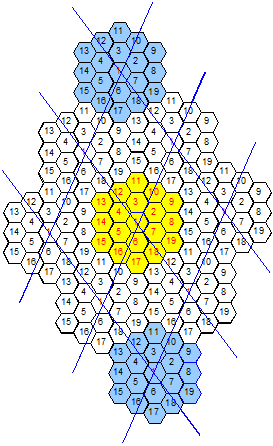
**Figure 185: Wrap-around with ’9’ clusters of 19 cells showing the toroidal nature of the wrap-around surface**
In the “ploting options” panel, you can toggle wrap-around plotting to allow easier selection of correct cell.