# 4.1 iRSSunwanted

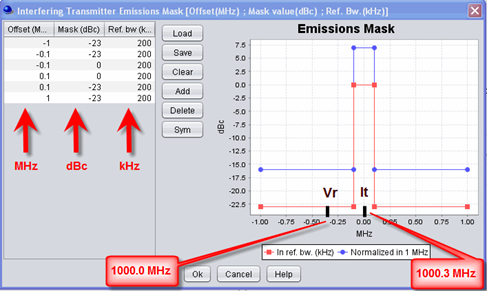
The following parameters should be changed in the simulation: (i) the interferer operates at 1000.3 MHz and (ii) outside the emission bandwidth, the attenuation is -23 dBc/200 kHz.

The corresponding power may derived using the known equation:

*(Eq. 20)*

[![image.png](https://wiki.cept.org/uploads/images/gallery/2026-04/scaled-1680-/LkF1IdJS3brKgBOD-image.png)](https://wiki.cept.org/uploads/images/gallery/2026-04/LkF1IdJS3brKgBOD-image.png)

<div class="fabric-editor-block-mark fabric-editor-alignment" data-align="end" id="bkmrk--1"><div class="inline-extension-renderer css-e2q2ep"><div class="_kqswh2mm" data-testid="ForgeExtensionContainer"><div class="_19itglyw _vchhusvi _r06hglyw _kqswh2mm" data-testid="hosted-resources-iframe-container"></div></div></div></div>Then, in this example, outside the emission bandwidth (offset between –0.1 MHz and -1 MHz and between 0.1 MHz and 1 MHz), the power is equal to:

[![image.png](https://wiki.cept.org/uploads/images/gallery/2026-04/scaled-1680-/0yrjzOgCvrfjrVnp-image.png)](https://wiki.cept.org/uploads/images/gallery/2026-04/0yrjzOgCvrfjrVnp-image.png)

The complete unwanted emission mask is provided in the below figure.
![image.png](https://wiki.cept.org/uploads/images/gallery/2026-04/scaled-1680-/LYfLyRBWL0uFt3Q1-image.png)

**Figure 99: Unwanted emission mask**

Using the previous assumptions, it is possible to derive the interfering power received by the Victim link receiver *<u data-renderer-mark="true">within its bandwidth</u>* as described in ANNEX 5: on page 274. This is called the iRSS<sub data-renderer-mark="true">unwanted</sub>:

 *(Eq. 21)*

[![image.png](https://wiki.cept.org/uploads/images/gallery/2026-04/scaled-1680-/fjRmJOEE13LTjEVE-image.png)](https://wiki.cept.org/uploads/images/gallery/2026-04/fjRmJOEE13LTjEVE-image.png)

[![image.png](https://wiki.cept.org/uploads/images/gallery/2026-04/scaled-1680-/qIi4YENJnbtoDGZm-image.png)](https://wiki.cept.org/uploads/images/gallery/2026-04/qIi4YENJnbtoDGZm-image.png)

[![image.png](https://wiki.cept.org/uploads/images/gallery/2026-04/scaled-1680-/lDDTr6hKX9oaPRrP-image.png)](https://wiki.cept.org/uploads/images/gallery/2026-04/lDDTr6hKX9oaPRrP-image.png)

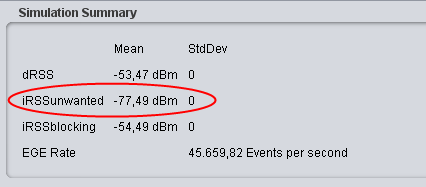
This can be checked by running a simulation and displaying the iRSS<sub data-renderer-mark="true">unwanted</sub> signal as depicted in Figure 100.

![image.png](https://wiki.cept.org/uploads/images/gallery/2026-04/scaled-1680-/gfyeqmmOl2fSOo8P-image.png)Figure 100: Mean iRSS<sub data-renderer-mark="true">unwanted</sub>

![image.png](https://wiki.cept.org/uploads/images/gallery/2026-04/scaled-1680-/IfnQV0LWDE7MaPIg-image.png)

**In this example there is no bandwidth correction factor to be applied to the calculation of the iRSS<sub data-renderer-mark="true">unwanted</sub> since the <span data-highlighted="true" data-vc="highlighted-text"><span class="_kqswh2mm"><span class="_5pioz8co _189e1dm9 _1il9buyh _19lc184f _d0altlke" data-testid="definition-highlighter">VLR</span></span></span> bandwidth and the <span data-highlighted="true" data-vc="highlighted-text"><span class="_kqswh2mm"><span class="_5pioz8co _189e1dm9 _1il9buyh _19lc184f _d0altlke" data-testid="definition-highlighter">ILT</span></span></span> reference bandwidth have the same value (i.e. 200 KHz).**

**Examples of correction bandwidth can be found in section 3.3.8**