# 3.3.8 Emission, reference, VLR bandwidth relationship and bandwidth correction factor

The proposed exercise considers the case where the <span data-highlighted="true" data-vc="highlighted-text"><span class="_kqswh2mm"><span class="_5pioz8co _189e1dm9 _1il9buyh _19lc184f _d0altlke" data-testid="definition-highlighter">VLR</span></span></span> bandwidth is the same as the emission bandwidth and the reference bandwidth.

This section aims at illustrating the interaction between the emission bandwidth (It<sub data-renderer-mark="true">BW</sub>), reference bandwidth (Bref), <span data-highlighted="true" data-vc="highlighted-text">VLR</span> bandwidth (<span data-highlighted="true" data-vc="highlighted-text">VLR</span><sub data-renderer-mark="true">BW</sub>) and any bandwidth correction factor. This section provides examples where these values are different and its’ effect on the iRSS calculation.

### Relationship between Emission bandwidth and Reference bandwidth

For a fixed VLR<sub data-renderer-mark="true">BW</sub> = 200 kHz, and fixed It<sub data-renderer-mark="true">BW</sub>= 200 kHz, the attenuation Att(dBc/Bref) will be different depending on the values of the Bref in order to achieve the same interference power level.

 **Case 1, It<sub data-renderer-mark="true">BW</sub> &gt; Bref :**

Bref = 100 kHz, with Att = -3 dBc/Bref, iRSS = -54.49 dBm;

As mentioned in Section A7.5 on p.287, if the reference bandwidth is lower than the emission bandwidth then the attenuation must be defined with negative sign;

 **Case 2, It<sub data-renderer-mark="true">BW</sub> = Bref:**

Bref = 200 kHz, with Att = 0 dBc/Bref, iRSS = -54.49 dBm;

If the reference bandwidth is equal to the emission bandwidth then the attenuation should be set as zero.

**Case 3, It<sub data-renderer-mark="true">BW</sub> &lt; Bref:**

Bref = 400 kHz, with Att = 3 dBc/Bref, iRSS = -54.49 dBm;

If the reference bandwidth is larger than the emission bandwidth then the attenuation must be defined with positive sign.

Please note that, it is best practice and recommended that the user set the reference bandwidth as the same value as the bandwidth of the emission mask, to avoid any unexpected scaling effect.

### Relationship between Emission bandwidth and Victim link receiver bandwidth

  
For a fixed Bref = 200 kHz and a fixed It<sub data-renderer-mark="true">BW</sub>= 200 kHz, depending on the size of the <span data-highlighted="true" data-vc="highlighted-text"><span class="_kqswh2mm"><span class="_5pioz8co _189e1dm9 _1il9buyh _19lc184f _d0altlke" data-testid="definition-highlighter">VLR</span></span></span><sub data-renderer-mark="true">BW</sub> a bandwidth correction factor is applied or not. Calculations presented here are mainly illustration of effect or relation between emission Bw nad <span data-highlighted="true" data-vc="highlighted-text">VLR</span> Bw in the co-frequency case.

**Case 4, It<sub data-renderer-mark="true">BW</sub> = <span data-highlighted="true" data-vc="highlighted-text">VLR</span><sub data-renderer-mark="true">BW</sub>:**

<span data-highlighted="true" data-vc="highlighted-text">VLR</span>**<sub data-renderer-mark="true">BW</sub>** = 200 kHz, iRSS = -54.49 dBm;

**Case 5, It<sub data-renderer-mark="true">BW</sub> &gt; <span data-highlighted="true" data-vc="highlighted-text">VLR</span><sub data-renderer-mark="true">BW</sub>:**

<span data-highlighted="true" data-vc="highlighted-text">VLR</span>**<sub data-renderer-mark="true">BW</sub>** = 100 kHz, iRSS = -57.5 dBm;

As shown in ANNEX 22: on p. 422, when the It<sub data-renderer-mark="true">BW</sub> &gt; <span data-highlighted="true" data-vc="highlighted-text">VLR</span><sub data-renderer-mark="true">BW</sub>, the interfering power in the <span data-highlighted="true" data-vc="highlighted-text">VLR</span> is reduced due a bandwidth correction factor automatically applied in SEAMCAT. As a results, the iRSS value decreases compare to a case where It<sub data-renderer-mark="true">BW</sub> = <span data-highlighted="true" data-vc="highlighted-text">VLR</span><sub data-renderer-mark="true">BW</sub>.

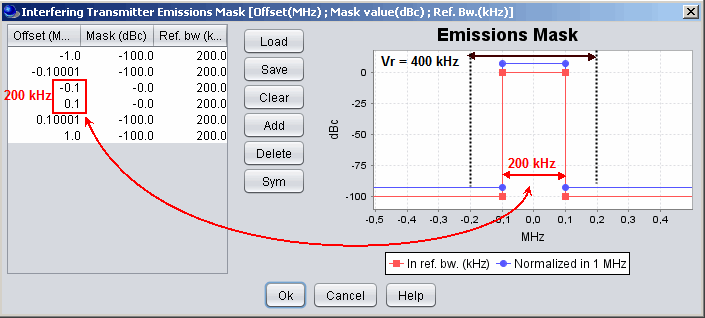
**Case 6, It<sub data-renderer-mark="true">BW</sub> &lt; <span data-highlighted="true" data-vc="highlighted-text">VLR</span><sub data-renderer-mark="true">BW</sub>: Case of <span data-highlighted="true" data-vc="highlighted-text"><span class="_kqswh2mm"><span class="_5pioz8co _189e1dm9 _1il9buyh _19lc184f _d0altlke" data-testid="definition-highlighter">ILT</span></span></span> Spectrum emission mask when the Tx spectrum is sharply reduced outside its reference bandwidth**

<span data-highlighted="true" data-vc="highlighted-text">VLR</span>**<sub data-renderer-mark="true">BW</sub>** = 400 kHz, iRSS = -54.49 dBm;

As illustrated in ANNEX 22:, when the It<sub data-renderer-mark="true">BW</sub> &lt; <span data-highlighted="true" data-vc="highlighted-text">VLR</span><sub data-renderer-mark="true">BW</sub>, there is no bandwidth correction factor applied to the interfering emitted power since the all the energy is “seen” by the <span data-highlighted="true" data-vc="highlighted-text">VLR</span>. Therefore the iRSS is equal to the case where It<sub data-renderer-mark="true">BW</sub> = <span data-highlighted="true" data-vc="highlighted-text">VLR</span><sub data-renderer-mark="true">BW</sub>. Note also that since the emission bandwidth of the interferer is smaller than the victim, SEAMCAT will complain that the spectrum emission mask of the interferer is not defined with the range of the victim bandwidth, therefore you need to increase the out of band emission.
![image.png](https://wiki.cept.org/uploads/images/gallery/2026-04/scaled-1680-/4DUlngx0BBFvFUDH-image.png)

<div class="rich-media-item mediaSingleView-content-wrap image-align-start css-17voqo2" data-layout="align-start" data-media-vc-wrapper="true" data-node-type="mediaSingle" data-renderer-start-pos="1516" data-vc="media-single" data-width="554" data-width-type="pixel" id="bkmrk-figure-92%3A-illustrat"><div class="css-110bcf8"><div data-alt="" data-collection="contentId-493565" data-context-id="493565" data-file-mime-type="" data-file-name="file" data-file-size="1" data-height="318" data-id="787351f4-8a39-432d-ae93-99c33ec84cc7" data-node-type="media" data-renderer-start-pos="1517" data-type="file" data-width="705"><div class="_2rko18qm _vchhusvi _kqswh2mm _ect4ttxp _p12f1osq _c71l1osq _1bsb1qmm _4t3ine4n _1hlmd0i9 _1rquusvi _eg541i5c _mts3kb7n _1ntskb7n _yfmhtlke _5sb1v00u new-file-experience-wrapper" data-media-vc-wrapper="true" data-testid="media-card-view" id="bkmrk-figure-92%3A-illustrat-1"><div class="_1reo15vq _18m915vq _2rko18qm _1e0c1txw _kqswh2mm _p12f1osq _1bsb1osq _4t3i1osq _c71l1osq media-file-card-view" data-cursor="pointer" data-test-media-name="92.png" data-test-progress="1" data-test-source="remote" data-test-status="complete" data-testid="media-file-card-view"><div class="_kqswstnw _1bsb1osq _4t3i1osq _1e0c1txw _2lx21bp4 _1bah1h6o _4cvr1h6o align-center" data-testid="ImageRendererWrapper">![](blob:https://ecowiki.atlassian.net/ba4e46a1-2ea8-4e46-8903-301b5794a9f0#media-blob-url=true&id=787351f4-8a39-432d-ae93-99c33ec84cc7&collection=contentId-493565&contextId=493565&width=705&height=318&alt=&clientId=113268fe-fe5b-4bc3-8ff3-07965dbf1d18)**Figure 92: Illustration of the emission spectrum mask with respect to the <span data-highlighted="true" data-vc="highlighted-text">VLR</span> bandwidth in case 6**</div></div></div></div></div></div>**Case 7: It<sub data-renderer-mark="true">BW</sub> &lt; <span data-highlighted="true" data-vc="highlighted-text">VLR</span><sub data-renderer-mark="true">BW</sub>: Case of <span data-highlighted="true" data-vc="highlighted-text">ILT</span> Spectrum emission mask when the Tx spectrum have sloped characteristics outside its reference bandwidth**

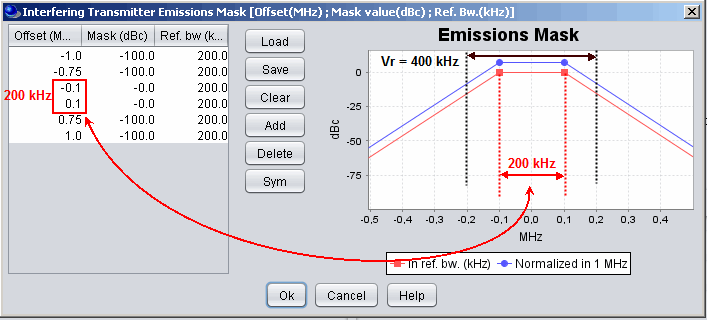
This is the same as case 6 (<span data-highlighted="true" data-vc="highlighted-text">VLR</span> = 400 kHz and Bref = 200 kHz) except that the spectrum emission mask (emission bandwidth 200 kHz) has slopes on both sides (Figure 93) which generates higher interference compared to the case 6 and the iRSS = -53.44 dBm
![image.png](https://wiki.cept.org/uploads/images/gallery/2026-04/scaled-1680-/kNI3Nt4H85sjWgTu-image.png)

<div class="rich-media-item mediaSingleView-content-wrap image-align-start css-lyf5b2" data-layout="align-start" data-media-vc-wrapper="true" data-node-type="mediaSingle" data-renderer-start-pos="2015" data-vc="media-single" data-width="553" data-width-type="pixel" id="bkmrk-figure-93%3A-illustrat"><div class="css-5mfdbi"><div data-alt="" data-collection="contentId-493565" data-context-id="493565" data-file-mime-type="" data-file-name="file" data-file-size="1" data-height="320" data-id="2ad47554-6a2d-4112-83aa-771c4b124652" data-node-type="media" data-renderer-start-pos="2016" data-type="file" data-width="708"><div class="_2rko18qm _vchhusvi _kqswh2mm _ect4ttxp _p12f1osq _c71l1osq _1bsb1qmm _4t3ine4n _1hlmd0i9 _1rquusvi _eg541i5c _mts3kb7n _1ntskb7n _yfmhtlke _5sb1v00u new-file-experience-wrapper" data-media-vc-wrapper="true" data-testid="media-card-view" id="bkmrk-figure-93%3A-illustrat-1"><div class="_1reo15vq _18m915vq _2rko18qm _1e0c1txw _kqswh2mm _p12f1osq _1bsb1osq _4t3i1osq _c71l1osq media-file-card-view" data-cursor="pointer" data-test-media-name="93.png" data-test-progress="1" data-test-source="remote" data-test-status="complete" data-testid="media-file-card-view"><div class="_kqswstnw _1bsb1osq _4t3i1osq _1e0c1txw _2lx21bp4 _1bah1h6o _4cvr1h6o align-center" data-testid="ImageRendererWrapper">![](blob:https://ecowiki.atlassian.net/b43c5056-41ab-4454-9186-c12fbce8fe5a#media-blob-url=true&id=2ad47554-6a2d-4112-83aa-771c4b124652&collection=contentId-493565&contextId=493565&width=708&height=320&alt=&clientId=113268fe-fe5b-4bc3-8ff3-07965dbf1d18)**Figure 93: Illustration of case 7 and the “extra” interfering energy to the <span data-highlighted="true" data-vc="highlighted-text">VLR</span> due to**   
 **the slope in the emission mask**</div></div></div></div></div></div>