3.6 Calculating the probability of interference
- Objective
- 3.6.1 Compatibility calculation mode
- 3.6.2 Translation calculation mode
- 3.6.3 Example of probability of interference calculation
Objective

After the simulation of all events has completed, SEAMCAT will have calculated and stored the dRSS and iRSS vectors. Now it is possible to evaluate the probability of interference for the simulated scenario using the interference calculation control panel as shown in Figure 97.
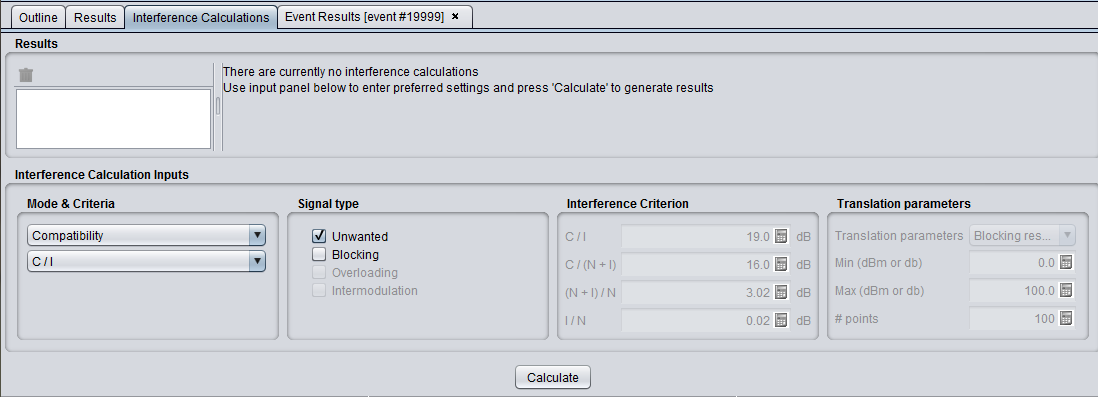
Any of the following parameters can be selected from the panel when calculating the probability of interference:
-
Calculation mode: compatibility or translation;
-
Which type of interference signal is considered for calculation: unwanted, blocking, overloading, intermodulation or a combination of them;
-
Interference criterion: C/I, C/(N+I), (N+I)/N or I/N:
3.6.1 Compatibility calculation mode
It is then possible to derive the C/I (i.e. dRSS/iRSS equivalent to dRSS-iRSS in dB):
dRSS/iRSS = -53.5-(-54.5) = 1 dB
Since the resulting C/I is below the protection criteria (19 dB), the probability of interference calculated by SEAMCAT (compatibility calculation mode) is equal to 1 as shown in Figure 98
3.6.2 Translation calculation mode
When the Translation mode is chosen, it is possible to calculate and display a chart of the probability of interference as a function of one of the following input parameters:
-
Output power of Interefering link transmitter;
-
Blocking response level of Victim link receiver;
-
Intermodulation response level of Victim link receiver.
The translation function, as shown as (#1) Figure 98 in, allows investigation of the probability of interference for varying power supplied (#2) to the interefering link transmitter. The power supplied (#3) to the interfering link transmitter should be equal to 15 dBm, which is 18 dB below the value used in the simulation (33 dBm). Effectively the C/I will be increased by 18 dB and reaches the level of 19 dB.

Figure 98: Translation function
3.6.3 Example of probability of interference calculation
The protection criteria to be used for the calculation of the probability of interference and the type of interference to be considered (unwanted and/or blocking) can be equally chosen (see Figure 97).
Using the unwanted mode, it is possible to derive the C/I:
dRSS/iRSSunwanted = -53.5- (-77.5) = 24 dB
Since the resulting C/I is above the protection criteria (19 dB), the probability of interference calculated by SEAMCAT (Interference calculation) is equal to 0).
The same conclusion is reached by using the C/(N+I) criteria. It should be noted that SEAMCAT performs a consistency check (ANNEX 19:) between the interference criteria (ANNEX 3:).
It is also possible to derive the (N+I)/N= -77.5-(-100)= 22.5 (since I>>N). Since the (I+N)/N which is obtained is above the protection criteria (3 dB), the probability of interference calculated by SEAMCAT (Interference calculation) is equal to 1).
The same conclusion is reached by using the I/N criteria.
Using the blocking interference mode (protection ratio) it is then possible to derive the C/I:
dRSS/iRSSblocking = -53.5 - (-113.5) = 60 dB
Since the C/I obtained is above the protection criteria (19 dB), the probability of interference calculated by SEAMCAT (Interference calculation) is equal to 0).
It is also possible to derive the (N+I)/N= -113.5-(-100)= -13.5. Since the (N+I)/N which is obtained is below the protection criteria (3 dB), the probability of interference calculated by SEAMCAT (Interference calculation) is equal to 0).
Then, by taking into account the sum of the two signal types, the probability of interference becomes equal to 1 (due to the unwanted emissions)