10.3 Interfering Link Transmitter to Victim Link Receiver Path (ILT -> VLR)
- introduction
- 10.3.1 Relative positioning of interfering link (Generic system)
- 10.3.2 Relative positioning of interfering link (Cellular system)
- 10.3.3 Interferers density
- 10.3.4 Pathloss correlation
- 10.3.5 Propagation Model
introduction
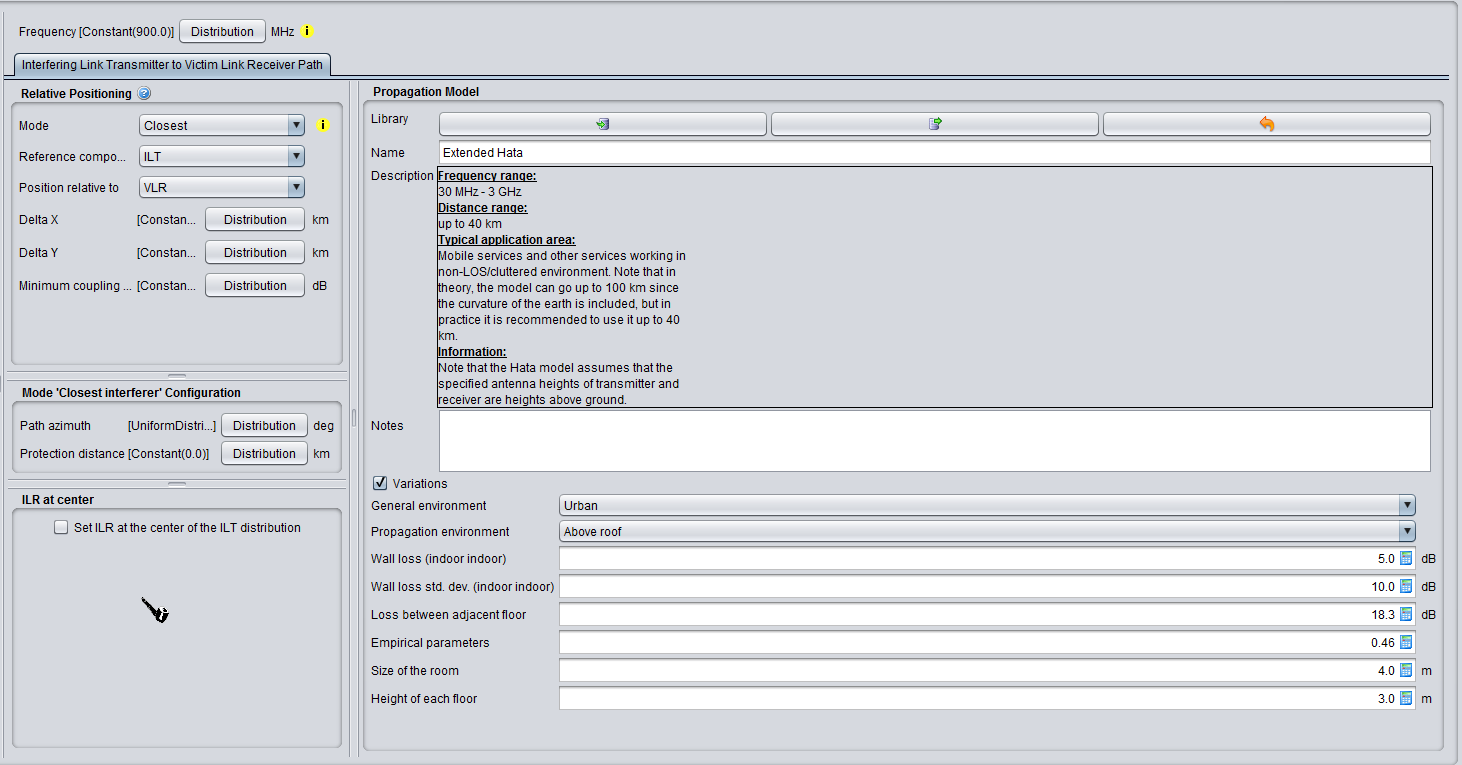
The ILT to VLR path can have several combinations as shown in Figure 224. Four panels characterised the path between the ILT and ILR.

10.3.1 Relative positioning of interfering link (Generic system)
The relative position of the Victim Receiver (VLR) and the Interfering Transmitter (ILT) depends on the various options presented below. There is a unique simulation radius (Rsimu) contrary to the 2 coverage radius (one for the victim and one for the interferer link). This is illustrated below in Figure 223 for a generic system interfering with a second generic system.
See ANNEX 12: for further details on the algorithm and conventions.

Depending on the system simulated several positioning options are possible when the generic system is the interferer and the victim is a generic system and cellular system as shown in Figure 224 and Figure 227 respectively.
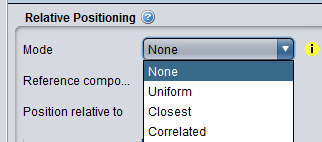
Each interfering signal calculation results from the contribution of
-
None: nactive interefering link transmitters located in a circular area with the simulation radius. You define yourself the radius. The random placement of the interefering link transmitters in this area is defined by the path azimuth and the path distance factor parameters.
See Annex A13.2.1 for detailed algorithm.
Table 42: ILT-VLR path - none mode (generic vs generic)
|
Description |
Symbol |
Type |
Unit |
Comments |
|
Reference component |
- |
|
- |
Positioning of the distributed component which is either the ILT or the ILR |
|
Position relative to |
- |
|
- |
Positioning of the reference component relative to either the VLR or the VLT |
|
Delta X |
∆X |
Distribution or Scalar |
km |
Horizontal distance between the transmitter and receiver. It can be used to shift horizontally the distributed receivers |
|
Delta Y |
∆Y |
Distribution or Scalar |
km |
Vertical distance between the transmitter and receiver. It can be used to shift vertically the distributed receivers |
|
Set ILR at he center of the ILT distribution |
- |
Boolean |
- |
set the distance factor distribution of the ILT with regards to the VLR. It overwrites the settings in the transmitter to reveicer path of the interferer |
|
Path azimuth |
|
Distribution or Scalar |
Deg |
Horizontal angle for the location of the ILT respect to the victim link. If constant, the Rx’s location will be on a straight line. If not, the location of the Rx will be on an angular area. (See Annex A12.3) |
|
Path distance factor |
|
Distribution or Scalar |
|
Distance factor to describe path length between the ILT and VLR. This factor will be multiplied by Rsimu to obtain the coverage area. Therefore, the trialled distance between ILT and VLR will be Rsimu *Path factor. E.g. if user enters a distribution 0…1, then the distance will be between 0 and Rsimu. If the path factor is constant, the ILT will be located on a circle around the VLR which means that the distance between the ILT and VLR will not change |
|
Simulation radius |
Rsimu |
|
km |
User defined |
|
Number of active transmitter |
nactive |
Scalar |
|
If nactive>1, this will result in spatially-independent generation of the specified number of Its, whereas the resulting total iRSS strength will be obtained by simple power summation of the individual iRSS signal values. |
|
Minimum coupling loss |
MCL |
Distribution or Scalar |
dB |
The minimum path loss. It is used in the calculation of the effective path loss (Section 7.6) |
|
Protection distance |
d0 |
Distribution or Scalar |
(km) |
minimum protection distance between the victim link receiver and interefering link transmitter (Section A13.2.3) |
|
Use of polygon |
|
|
|
You are also able to select a polygon shape as an alternative to the default circle. A various selection of polygon is available. You are able to rotate counter-clock wise (ccw) the polygon shape. |
|
Co-locate |
|
|
|
This feature allows deploying two interferers at the same location and their two transmitters could be transmitting at the same time while having different transmitter characteristics (e.g. emission mask, antenna radiation pattern…) |
-
Uniform density: Each interfering signal calculation results from the contribution of nactive interefering link transmitters uniformly located in a circular area. The parameters are taken from the system settings (see section A13.2.2.)
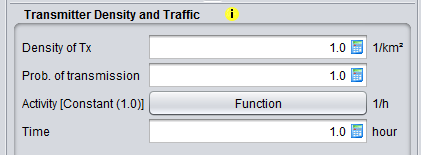
Table 43: ILT-VLR path - Uniform density mode (generic vs generic)
|
Description |
Symbol |
Type |
Unit |
Comments |
|
Reference component |
- |
|
- |
Positioning of the distributed component which is either the ILT or the ILR |
|
Position relative to |
- |
Boolean |
- |
Positioning of the Reference component relative to either the VLR or the VLT |
|
Delta X |
∆X |
Distribution or Scalar |
km |
Horizontal distance between the transmitter and receiver. It can be used to shift horizontally the distributed receivers. |
|
Delta Y |
∆Y |
Distribution or Scalar |
km |
Vertical distance between the transmitter and receiver. It can be used to shift vertically the distributed receivers. |
|
set ILR at he center of the ILT distribution |
- |
Boolean |
- |
Set the distance factor distribution of the ILT with regards to the VLR. It overwrites the settings in the transmitter to reveicer path of the interferer. |
|
Path azimuth |
|
Distribution or Scalar |
Deg |
Horizontal angle for the location of the ILT respect to the victim link. If constant, the Rx’s location will be on a straight line. If not, the location of the Rx will be on an angular area. (See Annex A12.3) |
|
Number of active transmitter |
nactive |
Scalar |
|
Number of active interferers in the simulation (nactive should be sufficiently large so that the (n+1)th interferer would bring a negligible additional interfering power). If nactive>1, this will result in spatially-independent generation of the specified number of Its, whereas the resulting total iRSS strength will be obtained by simple power summation of the individual iRSS signal values. |
|
Simulation radius
|
Rsimu |
|
km |
Note: the simulation radius value is readable only after each simulation |
|
Interferes density
|
|
|
|
A simulation radius is calculated, Rsimu. Interefering link transmitters will be randomly deployed within the area centred on the Victim link receiver and delimited by the simulation radius Rsimu. If a protection is defined then Interefering link transmitters will be randomly deployed within the area centred in the Victim link receiver and delimited by the protection distance and the simulation radius Rsimu . See Table 46 for information on the input parameter and Annex A13.2.2 for the calculation. |
|
Minimum coupling loss |
MCL |
Distribution or Scalar |
dB |
The minimum path loss. It is used in the calculation of the effective path loss (Section 7.6) |
|
Protection distance |
d0 |
Scalar |
(km) |
Minimum protection distance between the victim link receiver and interefering link transmitter (Section A13.2.3) |
|
Co-locate |
|
|
|
This feature allows deploying two interferers at the same location and their two transmitters could be transmitting at the same time while having different transmitter characteristics (e.g. emission mask, antenna radiation pattern…) |
-
Closest interferer: Each interfering signal calculation results from the contribution of just one interefering link transmitter. This ILT is randomly placed in a circular area with a simulation radius derived from the density of interferers. See Annex A13.2.4 for detailed alogorithm. The parameters are taken from the system settings (see section A13.2.4).
-

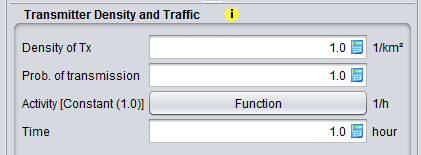
Figure 226: Transmitter density and traffic
Table 44: ILT-VLR path - Closest interferer mode (generic vs generic)
|
Description |
Symbol |
Type |
Unit |
Comments |
|
Reference component |
- |
|
- |
Positioning of the distributed component which is either the ILT or the ILR |
|
Position relative to |
- |
- |
- |
Positioning of the Reference component relative to either the VLR or the VLT |
|
Delta X |
∆X |
Distribution or Scalar |
km |
Horizontal distance between the transmitter and receiver. It can be used to shift horizontally the distributed receivers |
|
Delta Y |
∆Y |
Distribution or Scalar |
km |
Vertical distance between the transmitter and receiver. It can be used to shift vertically the distributed receivers |
|
Set ILR at he center of the ILT distribution |
- |
Boolean |
- |
Set the distance factor distribution of the ILT with regards to the VLR. It overwrites the settings in the transmitter to reveicer path of the interferer |
|
Path azimuth |
|
Distribution or Scalar |
Deg |
Horizontal angle for the location of the ILT respect to the victim link. If constant, the Rx’s location will be on a straight line. If not, the location of the Rx will be on an angular area. (See Annex A1.1) |
|
Number of active transmitter |
nactive |
Scalar |
|
Number of active interferers in the simulation (nactive should be sufficiently large so that the (n+1)th interferer would bring a negligible additional interfering power). If nactive>1, this will result in spatially-independent generation of the specified number of Its, whereas the resulting total iRSS strength will be obtained by simple power summation of the individual iRSS signal values |
|
Simulation radius
|
Rsimu |
|
km |
Note: the simulation radius value is readable only after each simulation |
|
Interferes density
|
|
|
|
The distance between the Victim link receiver and the Interefering link transmitter follows a Rayleigh distribution, where the standard deviation is given by . See Table 47 for information on the input parameter and Annex A13.2.4 for the calculation |
|
Minimum coupling loss |
MCL |
Distribution or Scalar |
dB |
The minimum path loss. It is used in the calculation of the effective path loss (Section 7.6) |
|
Protection distance |
d0 |
Scalar |
(km) |
minimum protection distance between the victim link receiver and interefering link transmitter (Section A13.2.3) |
|
Co-locate |
|
|
|
This feature allows deploying two interferers at the same location and their two transmitters could be transmitting at the same time while having different transmitter characteristics (e.g. emission mask, antenna radiation pattern…) |
Table 45: ILT-VLR path – Correlated mode (generic vs generic)
|
Description |
Symbol |
Type |
Unit |
Comments |
|
Reference component |
- |
|
- |
Positioning of the distributed component which is either the ILT or the ILR |
|
Position relative to |
- |
B |
- |
Positioning of the fixed interefer transmitter (ILT) or receiver (ILR) with the origin being. Reference component relative to either onthe VLR or the victim link transmitter (VLT) or receiver (VLR) on the option selected. |
|
Delta X |
∆X |
Distribution or Scalar |
km |
Horizontal distance between the transmitter and receiver. It can be used to shift horizontally the distributed receivers. |
|
Delta Y |
∆Y |
Distribution or Scalar |
km |
Vertical distance between the transmitter and receiver. It can be used to shift vertically the distributed receivers. |
|
Minimum coupling loss |
MCL |
Distribution or Scalar |
dB |
The minimum path loss. It is used in the calculation of the effective path loss (Section 7.6) |
In the case the victim system is a cellular system (CDMA or OFDMA, either UL or DL), the options are slightly changed as shown below, where Position relative to is always the BS of the reference cell.
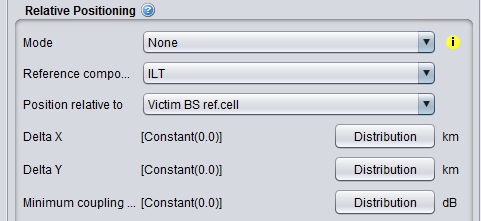
Figure 227: Relative positioning of a generic interfering link with a cellular victim system

10.3.2 Relative positioning of interfering link (Cellular system)
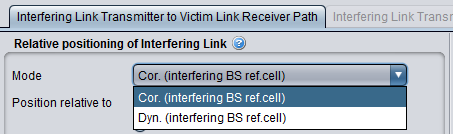
The relative position of the Victim Receiver (VLR) and the Interfering cellular system depends on the various options presented below.
-
Cor. (interfering BS ref. cell): in which case the relative location is explicitely defined by the dX/dY values given in the scenario and the reference is the BS ref.cell. It is a similar mode as described in Table 43 where the BS ref.cell of the cellular interferer is position with respect to the VLT or VLR depending on the selection;
-
Dyn (interfering BS ref.cell): this dynamic distance mode provides a a relative location that follows a uniform distribution in the distance and angle domain.
Table 46: ILT-VLR path – Correlated mode (cellular vs generic)
|
Description |
Symbol |
Type |
Unit |
Comments |
|
Position relative to VLT or VLR |
- |
Boolean |
- |
Positioning of the fixed interefer transmitter (ILT) or receiver (ILR) with the origin being either on the victim link transmitter (VLT) or receiver (VLR) on the option selected. |
|
Delta X |
∆X |
Distribution or Scalar |
km |
Horizontal distance between the transmitter and receiver. It can be used to shift horizontally the distributed receivers. |
|
Delta Y |
∆Y |
Distribution or Scalar |
km |
Vertical distance between the transmitter and receiver. It can be used to shift vertically the distributed receivers. |
|
Path azimuth |
- |
Distribution or Scalar |
Deg |
Horizontal angle for the location of the interfering BS ref.cell respect to the VLR or VLT |
|
Path distance |
- |
Distribution or Scalar |
km
|
Path length between the interfering BS ref.cell respect to the VLR or VLT |
|
Minimum coupling loss |
MCL |
Distribution or Scalar |
dB |
The minimum path loss. It is used in the calculation of the effective path loss (Section 7.6) |
-
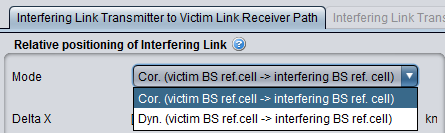
Cor. (victim BS ref.cell à interfering BS ref.cell): It is the same mode as described in Table 45 but where the BS of the reference cell of the victim cellular network is the reference position of the BS of the reference cell of the interfering cellular network.
-
Dyn. (victim BS ref.cell à interfering BS ref.cell): It is the same mode as described in Table 48, but where the BS of the reference cell of the victim cellular network is the reference position of the BS of the reference cell of the interfering cellular network.
10.3.3 Interferers density
The panel is activated if "Uniform density" or/and "closest interferer" mode is selected. See Annex A13.2.2 for more details on the calculation.
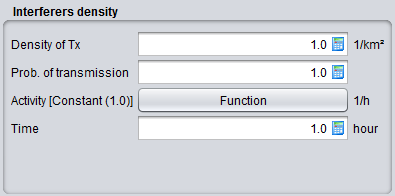 Figure 230: Interferers density panel (only in "Uniform density" and "closest interferer” mode)
Table 47: Setting up the interferes density
|
Description |
Symbol |
Type |
Unit |
Comments |
|
Density of transmitters |
densit |
Scalar |
1/km2 |
Maximum number of active transmitters per km2 |
|
Probability of transmission |
Pit |
Scalar |
% |
|
|
Activity |
activityit |
Function (X,Y) |
1/h |
Temporal activity variation as a function of the time of the day (hh/mm/ss) |
|
Time |
time |
Scalar |
hour |
Time of the day. If the activity function (above), here it should be specified which hour (from the defined range of function) should be considered in a simulation |
10.3.4 Pathloss correlation
The panel is activated if the victim is either OFDMA UL or OFDMA DL. It is decribed in more details in Section 9.11.
10.3.5 Propagation Model
You can choose the suitable propagation model to be applied when calculating signal loss between the ILT and the VLR. A choice and settings of propagation models are presented in ANNEX 17:.